Chris Long – Infuse Energy, Color & Drama Into Your Paintings!
Chris Long
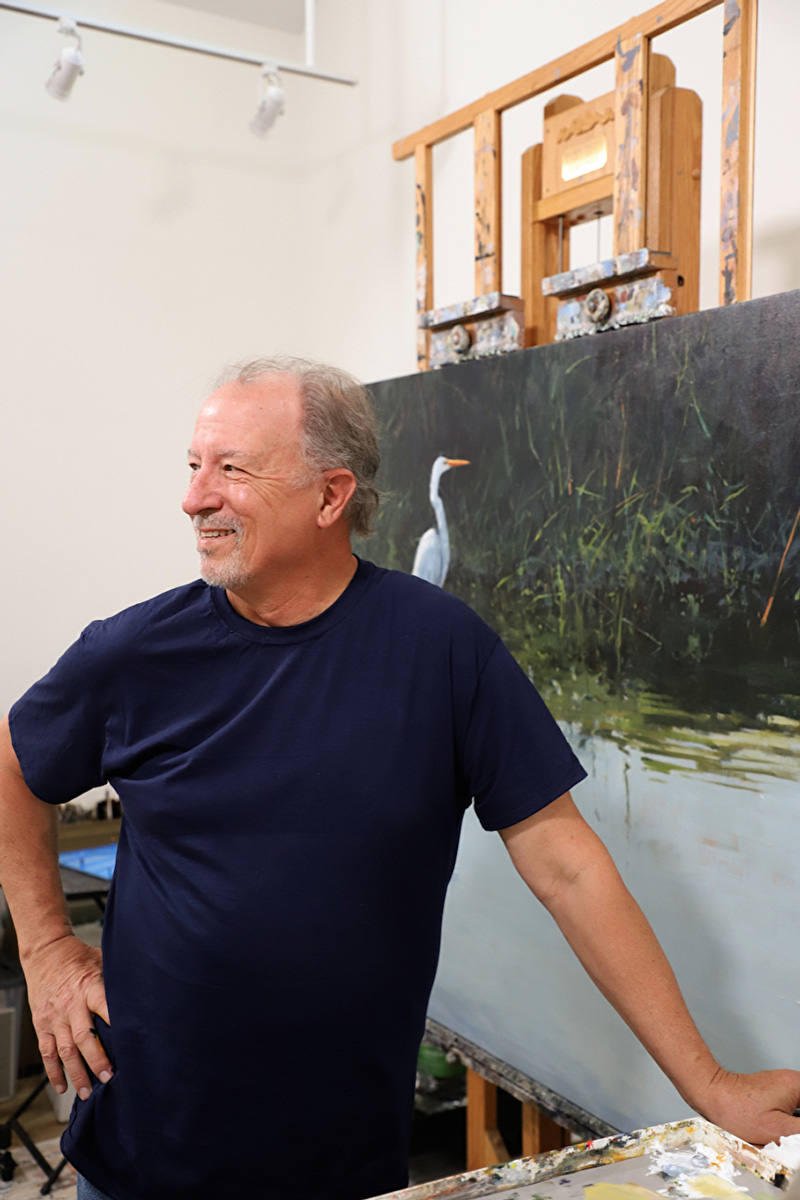
Chris Long is an American oil landscape painter and former sculptor whose work balances bold expression with deep connection to place. After earning a degree in sculpture and spending years teaching and creating three-dimensional work, he shifted entirely into painting in 2011 during a family trip to New Orleans. Since then, Chris has made painting his life’s work – producing over 15,000 original oils inspired by the places he’s visited, photographed, and remembered. Based in Rhode Island and often on the road with his family, Chris paints 2–4 originals daily and shares his evolving visual diary with collectors and fellow artists around the world. Follow Chris on Instagram as he pushes nearly 300,000 followers: @long_painter
Description
Join Chris Long (@long_painter) for an immersive three-day studio workshop designed to transform your landscape photos into bold, compelling paintings.
Each morning begins with a live demonstration as Chris walks you step-by-step through his dynamic process – showing how he edits reference material, simplifies design, amplifies color, and builds expressive brushwork that brings a scene to life.
Participants will complete multiple 8″x10″ studies from their own photo references, applying Chris’s methods immediately while receiving guidance and feedback throughout the process. Expect to paint, experiment, and push beyond simply “copying” a photo toward creating a painting with impact and personality.
Open to oil, acrylic, and gouache painters.
Bonus: Saturday morning may include outdoor information-gathering, quick studies, and visual exercises (weather permitting) to strengthen your reference and observation skills.
Supplies
Workshop participants should bring their normal tools/setup for oil, water-soluble oil, or acrylic painting, along with 2-5 primed 8×10 or 10×10 surfaces. They will also need a few landscape reference photos printed out.
Registration
Marc Hanson – Painting en Plein Air – Acrylics & Oils
Marc Hanson
Acclaimed landscape painter Marc Hanson is internationally recognized for his evocative oil, acrylic, and sometimes gouache paintings inspired by the beauty of the natural world. A Master Signature Member of Oil Painters of America, Marc has exhibited in galleries and museums across the U.S. and abroad and has been featured in major art publications. Raised in a military family, he studied at the Art Center College of Design in Pasadena and has devoted his life to capturing light, atmosphere, and the spirit of place in plein air and studio work. Marc teaches workshops nationally, guiding artists to deepen their observational skills and personal expression, helping them see and paint with greater confidence and clarity.
To see a full range of Marc’s amazing work visit his website at www.marchansonart.com
Description
Workshop participants will observe AGL’s 2026 national River Road Show juror and judge as he performs demonstrations in the morning (and/or afternoon) with a break for lunch (12p-1p) then paint in the afternoon (1p-4p) with Marc giving individual guidance to participants. Due to the Louisiana summer heat this workshop will be a hybrid plein air and studio painting adventure. We may gather plein air studies in the mornings finishing larger scaled final paintings indoors; spending as much time en plein air as weather and heat permit. Exact plein air location(s) to be determined: (likely LSU’s Burden Museum and Gardens.)
Supplies
This is a Recommended Supply List … If you don’t have any supplies then by all means use this as a starting point. If you are already comfortable with what you are using, use those supplies. Buy as good as you can afford, but don’t buy so expensive that you’re afraid to use them. Quality in paint DOES make a HUGE difference. If you were to splurge in any two areas of the materials you use, it should be in the quality of the paint you buy, and the easel you use.
*REQUIRED* Exception … *Bring at least one 12×16, 14×18 or 16×20 divided into fourth’s (1/4’s). Use tape to divide it equally vertically and horizontally so that you have 4 smaller areas to paint exercises on. *Bring IVORY BLACK PAINT!
EASELS … *Bring equipment made to be used painting outside with.* A French easel, OpenBoxM, EasyL, Art Box and Panel (made by James Coulter and my personal favorite), Strada, just some examples of what is available. A French full or half box is fine as long as you don’t have issues with carrying it as they are quite heavy. The others can all fit into a bag or back pack for transporting.
BRUSHES … Hog Hair bristle Flats and Brights in sizes ranging from #4 to #12 … # 6, 7 & 8 used most often. There are so many brands of very good brushes now that I recommend you look at what others are using, ask them what they think about them, and then try them out for yourself. Any other brushes, including some cheap’o Ox Hair brushes will at times come in handy.
PALETTE COLORS … I’ve found that the best palette for ‘students’ to use in a workshop is the Split Primary Palette. That means that you’ll have a warm and cool version of each of the primary colors, plus white. You can add to that if your experience allows it, but all we “Require” for the workshop is the following list of colors. Brands will only be specified when a color is unique to a Brand. I will be doing a color demonstration using the palette listed below.
*Note – If you’re an acrylic painter this same palette can be purchased with colors of the same names. Acrylics require a few more items to bring along if you want to paint with them. If you do, ask us and I will give you additional information about that.
Split Primary Palette
Titanium White – We like Utrecht Titanium White. Sometimes mixed with a drying white. For that I recommend W&N Griffon Fast Drying Alkyd – Titanium White.
Cadmium Yellow Lemon
Cadmium Yellow Deep or Medium
Cadmium Red Light
Permanent Alizarin … W&N, Gamblin, Utrecht are fine.
Ultramarine Blue
Manganese or Cerulean Blue Hue
Perylene Black (a Winsor Newton color)
Ivory Black
PAINTING KNIVES … An assortment of spade shaped palette knives … 1/2″, 1″, 2″ and longer are very useful too.
WHAT TO PAINT ON … For a 3 day workshop, plan on needing 2 or 3 panels or canvases a day in sizes of 9×12 to 11×14. Don’t bring panels larger than 12×16 unless you’re Very experienced. (*see note at top about the exception to this). Bring more than that if you plan to paint before or after class time. Any oil or acrylic primed panels or boards, stretched cotton or linen canvases. Heavy watercolor paper, mat board, museum board, or hardboard (MDF) primed with acrylic primer is perfectly fine to paint on. Centurion makes some inexpensive linen panels that are nice to paint on. Another option is to paint on the inexpensive canvas boards and canvases that Utrecht, Blick, Hobby Lobby, and Michael’s sell. These are fine for class work. If you use these however, we suggest that you re-prime them with an acrylic primer. They are a much better painting surface with an additional coat of primer.
GENERAL SUPPLIES … Umbrella, Brush washer for Gamsol or Turpenoid , Water bottle for drinking, Sunscreen, Hat, Bug Spray, Paper towels or cotton rags, Plastic trash bags, Gloves or Gloves In A Bottle (to protect hands from solvents and paint). It never hurts to have a multi- tool like a Leatherman in the bag, and some baby wipes for hand cleaning.
Registration
This workshop has already started.
Vicki Norman – Capturing Light and Color en Plein Air
Description
Accurate and sensitive color perception is the key to capturing a sense of light in a painting. Each location has its own unique atmosphere. Developing your ability to recognize subtle qualities in the temperature of the light and its effect on the local colors of stone, water and foliage in the landscape are the keys to successfully conveying a sense of place and atmosphere in your paintings. By learning to accurately observe and reliably match the colors you perceive in a scene it is possible to, communicate the feeling of the place very effectively, small details and idiosyncrasies become less important, if we can get the big color relationships correct they will do a lot of the work in explaining the time of day and the shape of the land for us, leaving the painter free to enjoy the more creative elements of the process such as brushwork, surface quality, rhythm, line and harmony.
In this workshop we will begin with some color theory and fundamental principles. Building from these we will learn a reliable three step process for identifying and matching colors accurately. We will use language to help us analyze color in a specific way, allowing us to observe and replicate color with more accuracy – through accurate perception and reproduction of color we can create an accurate depiction of light in our work. We will employ our new skills in a series of exercises and color studies painted from direct observation with the goal of capturing the unique sense of light and color in each subject. In learning to paint the color of the light, we can learn to capture the atmosphere of an interior or exterior scene more efficiently. Increased accuracy and efficiency can reduce the need for detail and allow the painter to create a sense of time and place in a more freely expressive way. Exact painting location to be determined: (likely LSU’s Burden Museum and Gardens.)
Vicki Norman
Based in Newlyn, Cornwall, Vicki Norman is a full-time fine artist and highly regarded instructor, represented by leading galleries across the UK. She earned her BA in Fine Art in 2000 and has been teaching since 2005, later completing a postgraduate certificate in post-16 education. Teaching remains a central part of her creative practice.
A lifelong student, Vicki has studied with master painters worldwide, blending traditional techniques with a fresh, contemporary approach. Her work is strongly influenced by plein air painting, where working quickly on location allows her to capture atmosphere, light, and color with an impressionistic sensibility.
Vicki’s paintings have received awards in Europe and the United States, including recognition from the Royal Institute of Oil Painters in London and the Oil Painters of America. She is also a Brand Ambassador for Michael Harding Handmade Artists’ Oil Colours and is widely admired for her mastery of color, clear instruction, and infectious enthusiasm.
Supplies
Participants should bring their usual favorite painting medium and tools/setup for plein air painting.
Registration
Charlie Hunter – Losing My Edge: Oil – en Plein Air
Charlie Hunter
Charlie Hunter is a nationally recognized painter of the post-pastoral American landscape. His distinctive, low-chroma work and superb draftsmanship, heavily reliant on a mastery of values, edges and composition, utilizes a variety of unorthodox techniques and tools that reference both photographic and painterly traditions.
Hunter has won first and grand prizes at top plein air events around the country, including Easton, Laguna, and Door County, and has served as judge or juror at many more. With painter Larry Moore, Hunter created the En Train Air painting train, and Hunter’s REASONABLY FINE ART TALK livestream maintains a fervent following.
Hunter’s work centers upon rural and small town America and how the past is evidenced in the present-day. Initially a graphic designer of tour posters for musicians such as the Jerry Garcia Band, Bob Dylan, and The Clash, Hunter became a music manager and event producer before turning to painting full time. Hunter’s 2025 activities included solo shows at McLarry Fine Art in Santa Fe and William Baczek Fine Arts in Northampton, MA, winner of the Architectural award at Art in the Open in Wexford, Ireland, and residency at the Tides Institute in Eastport, Maine.
Description
From Bellows Falls, VT, prominent American plein air artist and 2026 Teche Plein Air judge, Charlie Hunter, will be in Baton Rouge for a one-day workshop opportunity! Twelve lucky participants will spend the day observing and painting with Charlie en plein air. Charlie will perform a morning demonstration en plein air with participants painting in the early afternoon (1p-4p). Charlie will give individual counsel as needed and finish the day with an informative group critique.
Award-winning Putney Painter Charlie Hunter strives to paint beautifully that which is not traditionally considered beautiful. His stunning work transforms ordinary objects into powerful and dynamic works of art that speak to the viewer. Using a limited palette, we will learn to use values, edges and composition to build bold paintings. Be prepared to step outside of your comfort zone as you strengthen your painting skills.
We will gather at 10:00 am, and get to know one another a bit, talking a little about who we are, and where we are on our creative journey. From around 11:00 am until 12:30 or so, I’ll do a demonstration painting, and then each participant will set up and work on their own.
Lunch break is at participant’s discretion. As I have compromised mobility on my right side, I will not come around and hover in the background – I will sit myself down somewhere, and folks will come to me if they have questions or seek my counsel.
At 3:00 pm, everyone will gather, setting up their easels in a half-circle, with their painting on display. We will do a positive group critique and discussion of each work until 4 pm.
Supplies
It is expected that you already know at least the rudiments of painting, that you are familiar with the challenges of painting outdoors, that you know how to set up and take down your easels, etc.
I am not here to dictate how one “should” paint, nor am I here to instruct on basic drawing or painting fundamentals. There is no one “correct” way to approach the creative process; each of us reacts to shadows, forms and light differently; each of us has our own way of telling a story.
Metaphorically, I view this much like a one-day creative writing workshop: we trust you already know what the parts of speech are and that you know how to write a grammatical sentence. In the short amount of time we have together, using the same visual prompt, as it were, we will all strive to write a couple of terrific paragraphs, and then we will talk about how it went, the triumphs and challenges; the great sentences and the ones that could use a little work.
Therefore, it should be clear that I do not have a required materials list. If you have a set-up you regularly use for outdoor painting, that’s wonderful – just use it. Pastel, acrylic, gouache, oil – I don’t care what your medium is – I want to see how you tell your story.
That said, I do understand that some folks are interested in seeing how I paint in a live context, and may be interested in trying on the “Charlie Hunter outfit” for a day. That is understandable; when I was developing my “voice” and participating in many workshops, I was very interested in absorbing everything I could from the visiting instructors. Even today, I will take two or three workshops a year to expand my own vocabulary.
Again, thanks so much for choosing to spend a day exploring beauty. In a world filled with ugliness and pain, we are lucky bugs to get to do this.
The following is a list of the rudiments of my plein air rig. For a really deep dive into all my materials, here is a link on my webpage that should satisfy even the most obsessive. These are not requirements – you probably know what works for you.
Surfaces:
I like a rigid panel with a slight tooth. Blick Belgian Linen Panels or Centurion Linen Panels (both with acrylic “all purpose” gesso) are commercial products with qualities most similar to my home-made panels. In terms of size, for an outdoor painting workshop, something easily transportable – like 6×12, 9×12, 8×16 or 11×14 – makes sense.
I make my own surfaces with inexpensive muslin from the local fabric store glued (with Amsterdam Acrylic Binder) to 1/4” gatorboard, sized with Golden Matte Medium, then three coats Amsterdam Acrylic Gesso. (There is a special feature about making these surfaces in EDGES, Hunter’s new video for Streamline).
If attempting my approach, please do not use inexpensive canvas boards, as the divots of fabric are too deep and will leave way too much paint in them. We also do not recommend the use of Gessoboard panels as you learn, for though they are a magnificent surface, the techniques used for paintings on Gessoboard differ somewhat from those used on the toothed surface.
Brushes:
Any decent-quality synthetic flats will work fine. My go-to plein air brushes are: Black Silver by Dynasty 1” synthetic flat, ⅝” synthetic flat, ½” synthetic flat, ¼” synthetic flat and a rigger/liner. Also a (preferably well broken-in) 2” (or larger) chip brush.
Paint Manipulators:
Flexible palette knife
6” Ettore squeegee
Q-Tips
Stim-U-Dent (mint flavor)
Miscellany:
Plein air easel (Hunter uses a Soltek)
Portable/foldable chair (for critique session)
Water bowl (or solvent cup)
Palette cup (for safflower oil)
Paper towels (Hunter likes Bounty or Kirkland)
Other stuff I carry in my plein air rig:
Toothbrush (for spattering)
Plant sprayer
Rosemary Sword Brush, Rosemary #37 Badger Blender
1” paint scraper with squeegee blade in place of razor blade, and/or 3” mini-squeegee
Stretcher-bar keys (come with some pre-stretched canvases)
If you are taking the “How can I be as Charlie as possible for a day” approach, we offer a “Starter Set” of mark-making tools we use (brushes, squeegees, etc) – here is the link to order.
Paints:
I use water-mixables, but that doesn’t mean you have to:
Cobra water-mixable Van Dyke Brown
Cobra water-mixable Titanium White
Cobra water-mixable Raw Umber
Cobra water-mixable Payne’s Grey
Cobra water-mixable Safflower Oil
I use water-mixable oils. Conventional oils (and OMS instead of water) would also probably work just fine for my technique, with the caveat that the two media do not behave exactly alike, so those using conventional oils would need to be ready to be slightly flexible when the unexpected occurs.
I recommend any conventional-oil-painters-trying-to-paint-like-Charlie use Rembrandt oil colors, as they and Cobra are both manufactured by Royal Talens and thus the pigment formulations should be near identical. Since I don’t use conventional oils anymore, I’m unable to troubleshoot what might or might not happen with conventional oil use. My process will not work – as far as I can figure out – with acrylic, gouache or watercolor. Artists who are following their own path and don’t care about Charlie’s techniques should use whatever materials they want.
Sketchbook:
Not specifically needed for this workshop, but should be part of everyone’s plein air practice:
I advocate artists develop a regular sketching practice, carrying a bound sketchbook in the car with them, and sketching 20-45 minutes at least two or three times a week. I like a hard pencil (like a Staedler 3H, but that’s really a matter of preference).
Registration
Kim Pierson – Perspective for Artists
Kim Pierson
Kim Pierson is an experienced art educator and practicing artist with over 21 years of teaching in gifted and talented programs for students ages 6–18. She also offers private art lessons for both children and adults. Kim holds a degree in Art Education and is passionate about sharing her love of creativity. Her favorite medium is oil paint, though she also enjoys working with ceramics. For Kim, teaching art is as fulfilling as creating it.
Description
Join us for two extended afternoons and master perspective in your work!
Day One: Introduction and practice. Multiple step-by-step demonstrations for how perspective works in various types of work, still life, landscape, etc. and time addressing a wide range of weak areas like ellipses and odd shapes in perspective.
Day Two: Review and apply to your own work. Students bring in a reference, draw a still life or use teacher-provided references to draw multiple shapes in perspective in the same environment using any medium of their choice. Instructor will encourage participants to bring in works or images of works they have trouble with in order to troubleshoot and correct perspective issues in the artist’s work on a one-on-one basis.
Class limited to 15 students.
Supplies
Day 1
20-30 sheets of drawing paper (minimum 8×10) (Copy paper is fine)
18″ ruler (12″ works but 18″ is better)
Pencils
Erasers
1 bright colored marker or highlighter
Day 2
Supplies from Day 1 that you still need
Personal Drawings/Paintings that need help with perspective
Personal supplies needed for fixing drawings/paintings.
Registration
Donate
Your donation in support of our mission is greatly appreciated.